Emerge Home
Senior Game Designer
Jan 2021 - MAR 2022 • CYBERDREAM (For Emerge)
Emerge Home is a social VR party game built around the Emerge Wave-1, an ultrasound tabletop device that emits patterns of sound you can physically feel. Four players compete across a suite of minigames using bare-hand tracking, with the Wave-1 adding a real sense of touch to VR. It shipped on the Meta Store as the first title planned for Emerge's platform.
Cyberdream was contracted by Emerge to build the flagship experience for their haptic device, intended as the first in an ongoing series for their platform. As the senior designer, I ran the project day to day alongside our producer and led the minigame team. I designed the social loop that framed the experience, and pitched 30+ minigame concepts, five of which shipped, each built to prove a different thing the Wave-1 could do.
The Constraint
A controller in your hand blocks the exact thing the product exists to deliver. The Wave-1 pushes ultrasound against your palm to simulate touch, and a gamepad occludes the palm. Every game had to run on bare-hand tracking, brand-new tech in 2021 with no established design language: movement, menus, and aiming all designed from scratch, on hardware that was still changing under us as we built.
The brief added a second constraint on top of that. Each minigame had to showcase a different capability of the device and still be worth playing on its own, so I designed the five as a set, each staking out a sensation no other game covered. Novelty tech is easy to demo and hard to make fun.
30+ → 5
concepts pitched, narrowed to the five that shipped, each proving a distinct Wave-1 sensation.
Major Contributions
-
Designed all 5 shipped minigames, each showcasing a different Wave-1 capability
-
Built a hand-tracking interaction model from scratch on new, unstandardized tech
-
Designed the social loop: gathering rooms, avatars, and the party hub
-
Pitched 30+ concepts and drove selection with the client
-
Led the minigame team and ran the project with the producer
-
Shipped on the Meta Store for Quest VR
01
Design Direction
One device, no controllers, five games to prove it
Designing the games as a set turned the whole suite into a tour of the hardware's range. I pitched 30+ concepts toward that goal, and the survivors weren't just the most fun, they were the ones that claimed distinct territory: a game that duplicated another's sensation got cut, however well it played.
The wrapper was deliberately childlike: the whole experience is themed like a school art project, all construction paper, crayon textures, and soft cartoon characters. New haptic tech can read as clinical, and the aesthetic did the opposite, making a first-of-its-kind device feel warm and safe to touch. It carried through everywhere, down to the gathering rooms players landed in before a match even started.


02
Minigame Design
Five sensations, mapped to five games
Two games mark the poles of what the Wave-1 could do. Everything else lives between them. In each, the haptic feedback and the mechanic are the same thing, not feedback layered onto a game that would work without it.
Piglet Panic
The device pushes a constant pressure into your palm, and in-game that reads as a stream of water you spray to wash a pen of piglets. Spread your fingers and the beam widens; close them and it tightens into a faster jet. The hardest sensation to make legible, because sustained pressure has no beginning or end, turned into the core input.
Up Up & Away
Pinch to grab a slingshot and pull back to fire at flying targets. As you draw, the pulses on your palm rise in strength and shift in rhythm, an eyes-free power meter you feel instead of read, which matters when your eyes are on a moving target. The exact opposite of Piglet Panic's steady note.

Cosmic Chaos
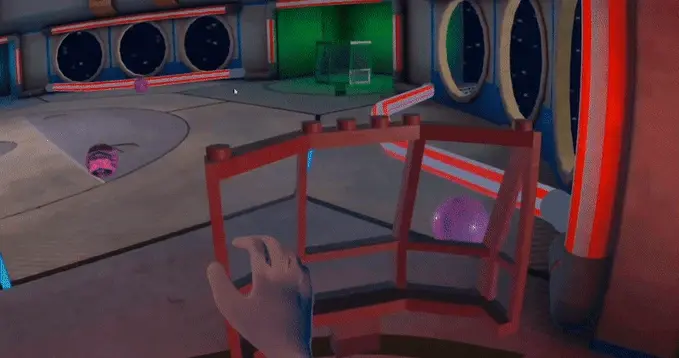
Air-hockey in the round. Fist-to-open-palm launches a ball at rivals' goals. Launch, block, and score each fire a distinct pulse, three events on one surface.
Sumo Slammers
Last one standing on a shrinking arena over lava. Tilt your hand to steer a ball and slam rivals off. Collisions and eliminations hit as sharp jolts.

Popcorn Poppers
Channel a beam of "microwave radiation" off your palm onto a giant skillet, heating kernels until they pop. The most focused, directional output in the set.

02
Minigame Design
Five sensations, mapped to five games
Two games mark the poles of what the Wave-1 could do. Everything else lives between them. In each, the haptic feedback and the mechanic are the same thing, not feedback layered onto a game that would work without it.

Piglet Panic
The device pushes a constant pressure into your palm, and in-game that reads as a stream of water you spray to wash a pen of piglets. Spread your fingers and the beam widens; close them and it tightens into a faster jet. The hardest sensation to make legible, because sustained pressure has no beginning or end, turned into the core input.

Up Up & Away
Pinch to grab a slingshot and pull back to fire at flying targets. As you draw, the pulses on your palm rise in strength and shift in rhythm, an eyes-free power meter you feel instead of read, which matters when your eyes are on a moving target. The exact opposite of Piglet Panic's steady note.
Cosmic Chaos
Air-hockey in the round. Track a shield to your hand, fist-to-open-palm to launch a ball at rivals' goals. Launching, blocking, and scoring each fire a distinct pulse, so the device speaks three different events on one surface.

Sumo Slammers
Last one standing on a shrinking arena above lava. Tilt your hand to steer a ball and slam rivals off the edge. Collisions and eliminations hit as sharp jolts, the device's answer to physical impact.

Popcorn Poppers
Channel a beam of "microwave radiation" reflected off your palm onto a giant skillet. Heat kernels until they pop. A concentrated, directional sensation, the most focused output in the set.
03
systems design
The social loop that held it together
The client's ambition went beyond one game. Emerge Home was meant to be the first title in an ongoing platform, so the social loop needed to work like infrastructure other games could plug into later, not just a wrapper for this one. Players launch into one of two themed gathering rooms, a beach and a modern cabin, rendered with Meta's Avatar system so everyone can see each other. The rooms aren't lobbies to wait in; they're seeded with interactive Wave-1 activities and a playable chess board, so the device is in your hands within seconds of arriving.
From there, players launch together into Emerge Party: five minigames, scored each round, highest total after the fifth wins, up to four players. Borrowing Mario Party's structure meant nobody needed a tutorial for the wrapper, which freed all the teaching for the genuinely new part: the haptics and the hands.
Under the hood it ran on Photon Fusion while it was still in beta, one more piece of unproven tech in a project stacked with them.


2
Themed social rooms
4
Players per match